
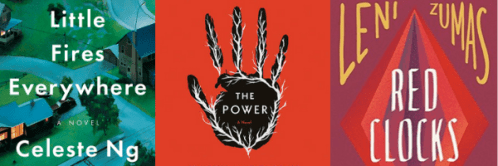
I have been meaning to type this review for a long time! But it was hard to put all of my thoughts together cohesively. I read these three books, by women and about aspects of being a woman, back to back to back and it left a very strong impression.
I will say at the outset that I feel like The Power and Red Clocks would have benefitted from an exploration of transwomanhood, as there were biological and legal concepts that would have been enriched by it, and of course I would always like to see a more culturally inclusive cast of characters. When we talk about feminism, in the year 2020, there is absolutely no reason we can’t have that discussion be bolstered and made more relevant by committing to intersectional feminism. Its absence in literature about gender, parenthood, and societal upheaval is loud.
Electricity
The Power, by Naomi Alderman, is a science fiction/superhero approach to gender inequality on a global scale, through a handful of POVs that we follow over the course of several years. What would happen to society if men were no longer considered as threatening because of a literal surge of power in women? Women gain the ability to channel electricity and shock others with it through a quasi-spiritual, quasi-evolutionary turn and every aspect of civilization is affected. Religion, politics, crime…violence against women no longer dominates any culture. It is fascinating and brutal, positing that such great harm comes at an enormous cost, even if it does seek to “balance the scales.”
5 out of 5 Earl Grey teas at a stressful state dinner.
Fire
Little Fires Everywhere, by Celeste Ng, tells the story of two families in the late 1990s: the Richardsons, a family of wealth and reputation in Shaker Heights, OH, and the Warrens, a free-spirited artist mother and daughter pair who come into the neighborhood after a lifetime of moving around.
We see the world of each of these mothers, and their obvious contrasts. The Richardson home is filled with plush furniture, Diet Cokes, and crown molding in every room. All seems well in the home, with the exception of rebellious Izzy, who rebels against her mother’s niceties and shallow pleasures in favor of Doc Martens, loud music, and radical political ideas. Meanwhile, a few streets over at their rental home, Mia and Pearl live amidst DIY furniture, stacks of photographs, and leftover Chinese food from Pearl’s part-time job. Pearl becomes close to the Richardson children, entwining the two mothers’ lives uncomfortably together.
Adding to the tension is a custody case that has the community completely divided: a Chinese-American baby girl was put up for adoption by a distraught young single mother, who now wants to reclaim custody. The themes of motherhood, “proper” parenting, and the middle class anxiety of the 1990s all seem to lead our families only to destruction, but within the chaos there might be hope, as well.
3.5 out of 5 Diet Cokes while flipping through a June 1998 Seventeen magazine.
Blood
Red Clocks by Leni Zumas is a dystopia so close to reality, it seems like the possibility of its world existing is only a few years away. Abortion is completely banned in America, and leaving the country to get the procedure done in Canada is blocked by an agreement between the two nations known as The Pink Wall. Abortion-seekers are extradited back to the US if they’re suspected of traveling for that purpose. We follow several women though extremely different worldviews and circumstances, though with more in common than first meets the eye.
A mysterious woman who seems out of time and place, a forest druid who refers to women’s “clocks” and “waters.”
An angry, intelligent woman racing the clock against an unjust law that would close the possibility of motherhood to her forever.
A young woman, terrified, not ready to have a child.
A lonely woman who loves her children but ultimately despises her marriage, and the unseen work of domesticity.
And a woman whose life we never truly inhabit. A life lived long ago, one which found solace not in family but in unfamiliar ice flows in the Arctic.
Their stories all highlight the different ways we experience the idea of motherhood, legacy, choice, jealousy, and our bonds with other women.
2.5 out of 5 strange cups of mushroom and dandelion brew to cure cramps and bloating. Wait…is that a twig floating in it?
 Earl Grey and A Million Words